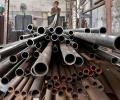
The imposition of safeguard duty, an uptick in exports, and an increase in input cost are driving steel prices higher. The latest round of price increase took place on Friday, with some steel mills increasing hot-rolled coil (HRC) prices by ~500-750 a tonne, according to price reporting and market intelligence firm BigMint. HRC is a benchmark for flat steel.

The Indian rupee experienced a significant surge against the US dollar following the Reserve Bank of India's measures to restrict banks from onshore forward markets. Despite this, the rupee remains under pressure from foreign capital outflows, a strong dollar, and rising crude oil prices.

The Indian trading and investment space has transformed exponentially in the last few years, and technology plays a pivotal part in how traders engage with the markets. In 2026, brokers are far more than order-execution platforms; they provide several value-added features to market participants to facilitate a data-driven and seamless trading experience.

Rupee slumped 69 paise to an all-time low of 92.18 against the US dollar in early trade on Wednesday, as a sharp spike in crude oil prices amid geopolitical tensions following the escalation of the US-Iran conflict weighed on investor sentiment.

Chinese Foreign Minister Wang Yi has urged Iran to guarantee freedom and safe passage through the Strait of Hormuz, a critical waterway for global oil trade, amid ongoing tensions with the US.

S&P Global Ratings has increased India's GDP growth forecast for the next fiscal year to 7.1 per cent, citing private consumption, investment, and exports as key drivers. However, the agency also cautioned that the conflict in the Middle East could strain India's fiscal position due to higher energy prices.

'Even last year, when India bought gold, the physical quantity was much less than the previous years.'

India has expressed serious concerns about the West Asia crisis and its potential impact on energy supplies and maritime stability, urging BRICS nations to find practical solutions to geopolitical challenges and unilateral sanctions.

Brokerage Bernstein has warned Prime Minister Narendra Modi that India risks squandering recent economic gains unless it accelerates structural reforms, particularly in jobs, manufacturing and innovation.

'FPIs are unlikely to return unless there is equilibrium between valuation premium and earnings growth.'

The central bank is yet to consider actions such as a rate hike or mobilising dollar inflows from non-resident Indians to boost forex reserves as it cannot afford to continue with them for long when the rupee's internationalisation tops its agenda, explains Tamal Bandyopadhyay.

According to the Economic Survey 2026, the appropriate stance for 2026 is therefore one of strategic sobriety rather than defensive pessimism.

India's merchandise exports experienced a slight decrease in February, while imports surged due to increased gold and silver purchases, leading to a widened trade deficit. The West Asia crisis is expected to further impact trade in the coming months.

Indian benchmark stock indices, Sensex and Nifty, closed nearly 1 per cent lower due to surging crude oil prices, weak global market trends, and significant foreign fund outflows, with geopolitical tensions and inflation concerns further dampening investor sentiment.
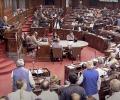
Opposition MPs in the Rajya Sabha criticised the Modi government's economic policies, citing the LPG crisis, lack of energy security, and concerns over the Economic Stabilisation Fund.

India's fiscal deficit is projected to reach 4.5 per cent of GDP for the current fiscal year, exceeding the budgeted target, as the government's policy responses to the West Asia conflict are expected to strain public finances, according to research firm BMI.

The shift towards power-hitting in cricket has led to a revolution in bat manufacturing, with makers using scientific precision and customisation to meet the demands of modern batters.

Reserve Bank of India (RBI) Governor Sanjay Malhotra stated that preventing second-round effects of supply shocks, where inflation expectations rise due to prolonged disruptions, is the primary role of monetary policy. He also defended the RBI's foreign exchange market interventions, asserting it did not commit to an 'indefensible peg'.

India should not stay on the margins of this initiative. There should be a serious debate about what would be in India's best interests asserts former foreign secretary Shyam Saran.

A senior Russian official has stated that Russia is prepared to supply fertilisers and other agricultural products to countries in the Global South and East, following concerns about the closure of the Strait of Hormuz impacting global fertiliser exports and food security.

Disciplined investors who ignore short-term fear build significant long-term wealth, notes Ramalingam Kalirajan
The Indian rupee rebounded against the US dollar following intervention by the Reserve Bank of India, amidst ongoing concerns about foreign capital outflows, rising crude oil prices, and geopolitical instability.

'It was diminishing even before Trump came to power.' 'The US was at the centre of the global economy. That position is going to become less and less important and less central.'

Mexico on Thursday imposed a tariff of up to 50 per cent on imports from its non-preferential trade partners, including India, a move that might hit New Delhi's annual $5.75 billion shipments to its third-largest car export market.

In a first, Indian oil public sector undertakings (PSUs) finalised a one-year contract to import around 2.2 million tonnes (mt) of liquefied petroleum gas (LPG) from the US. The LPG import deal comes at a time when negotiations for an India-US bilateral trade agreement (BTA) are gathering steam. Earlier in the month, US President Donald Trump had said Washington and New Delhi were "pretty close" to reaching a fair trade deal.

Indian stock markets tumbled sharply with the Sensex falling 800 points and nearly 4 lakh crore wiped out in a single session. Here are the 6 key factors, including rupee weakness and global cues, behind the crash.
Benchmark indices Sensex and Nifty tumbled in early trade on Friday after a two-day rally, tracking a weak trend in global peers, as the US-Iran conflict continues to be a key overhang for the markets. Track Sensex, Nifty50 movement and key market drivers for March 27, 2026.

India's defence sector is on the cusp of a 'super cycle' of growth, driven by escalating geopolitical conflicts and a strong policy push towards indigenous manufacturing, with major players like BEL, HAL, and BDL poised for significant order inflows and technological advancements.

The Vishva Hindu Parishad (VHP) has alleged a rise in targeted attacks on Hindus in Delhi, demanding a high-level review and the formation of a special task force to counter radical networks.

One Indian oil tanker successfully crossed the Strait of Hormuz, while others turned back after Iran signalled the waterway's closure, amidst rising tensions and disruptions to global energy flows.

Trump criticised Iran for attempting to use international waterways for leverage, stating that the United States had restrained itself only to allow space for negotiations.

Indian stock market benchmark indices Sensex and Nifty experienced a significant drop in early trade due to rising crude oil prices, bearish global market trends, and continuous foreign fund outflows.

10 stocks from the Nifty 200 index that offer good growth potential and scope to deliver decent returns from current levels, based on brokerage estimates.

The Indian rupee crashed to a record closing low against the US dollar due to rising global crude oil prices, a strengthening dollar, and geopolitical tensions in the Middle East.

The Reserve Bank of India's (RBI) cap on banks' forex positions provided only a temporary boost to the rupee, with the currency quickly reversing gains and breaching the 95-per-dollar mark due to persistent underlying pressures.

On President Putin's two-day trip to India, Jaishankar said for a "big" and "rising" country like India, it is important to maintain good cooperation with as many important players as possible in the world in line with freedom of choice.
Iran has reimposed restrictions on the Strait of Hormuz, with its forces opening fire on a passing tanker and forcing at least two Indian vessels to reverse course, escalating tensions in the region and raising concerns over energy supplies.

The Indian government is considering additional relief packages for vulnerable sectors like MSMEs to mitigate the impact of the ongoing West Asia crisis on the economy and inflation.

The Reserve Bank of India (RBI) has projected that crude oil prices will average USD 85 per barrel and the rupee will weaken to 94 against the dollar by FY27, according to its bi-annual Monetary Policy report.

'Policy consistency combined with timely and calibrated reforms are expected to ensure that India not only maintains macroeconomic stability, but also emerges as a globally competitive and inclusive economy.'
